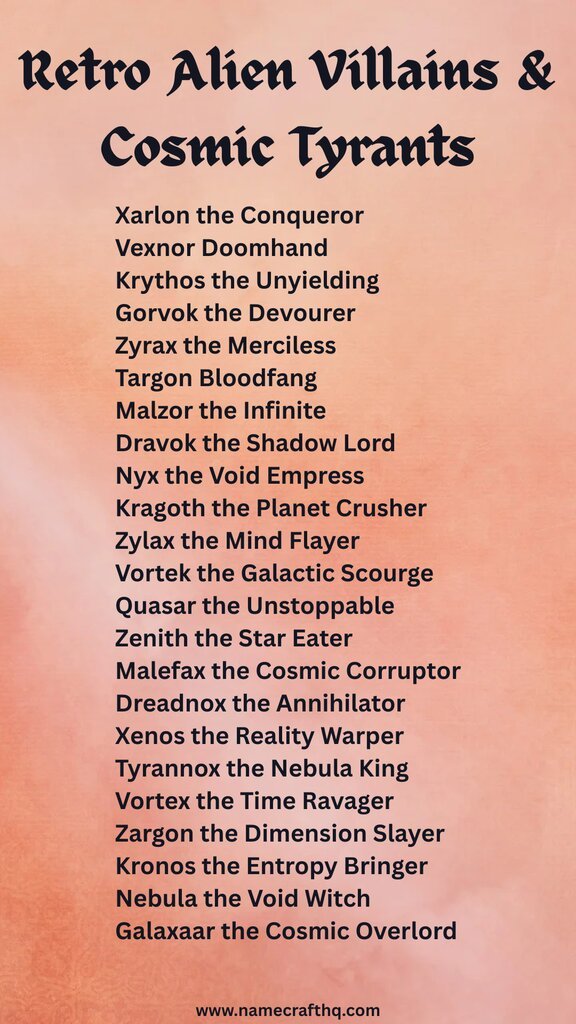
Crafting a truly immersive science fiction universe hinges on a multitude of details, but few elements are as immediately impactful, or as deceptively challenging, as integrating alien names into your narratives. It’s not just about slapping together some harsh consonants or a string of vowels; it’s about giving voice to a culture, hinting at a history, and subtly informing your reader about the very nature of beings from beyond our stars. A well-chosen alien name can instantly anchor your audience in your created world, adding layers of authenticity and depth that generic, human-sounding alternatives simply can't match.
At a Glance: Crafting Unforgettable Alien Names
- Names are World-Builders: They reflect culture, intelligence, history, and social structures.
- Balance is Key: Aim for unique, pronounceable, and memorable—avoiding both human clichés and impenetrable gibberish.
- Culture First: Develop your alien species' background before naming individuals.
- Phonetics Matter: Experiment with sounds and structures beyond human language norms.
- Consistency Prevails: Establish clear naming conventions and stick to them.
- Seek Feedback: Test your names aloud and get input from others.
- Leverage Tools: Use generators as a starting point, then refine.
- Avoid Stereotypes: Go beyond "Zorg" to create nuanced identities.
- Meaning Adds Depth: Embed meaning related to traits, roles, or origins.
More Than Just Sounds: Why Alien Names Truly Matter
Think for a moment about the names in your favorite sci-fi stories. Do they evoke a sense of the character’s origin? Do they hint at their species' temperament, their societal structure, or even their biology? This is the power of effective alien naming. It’s a core component of world-building, offering a direct conduit into the richness and complexity of extraterrestrial life.
A name isn't just a label; it’s an identity. For your alien characters, it’s a portal to their unique heritage, signifying their place within a broader alien culture. When done right, alien names don't just exist; they immerse the reader, pulling them deeper into the narrative's reality. Imagine a warrior race with names like "Grozthar" – the harsh sounds immediately convey strength and perhaps aggression. Conversely, a scholarly species might bear names like "Scholarith," subtly hinting at their intellectual pursuits and societal value. These names aren't arbitrary; they're narrative touchstones.
This deep dive into naming conventions becomes even more critical when you consider the concept of alien intelligence itself. As the profound challenge of depicting intelligence far beyond human capabilities suggests, alien minds might operate on entirely different principles – non-linear time, collective consciousness, or vastly expanded emotional and cognitive ranges. (Think of the Heptapods in Ted Chiang's Story of Your Life, who perceive time simultaneously, or the benevolent yet utterly alien Overlords in Arthur C. Clarke's Childhood's End.) Their names, therefore, should subtly reflect these fundamental differences. Perhaps a collective intelligence uses names that shift or combine, or a species with a non-linear perception of time incorporates elements of past, present, and future into a single, complex moniker. The more sophisticated your alien's intelligence and culture, the more intricate and significant their naming system should be.
This level of detail moves your story from mere speculative fiction to a profound exploration of what it means to be truly other. It creates a unique identity for your species, providing cultural depth that resonates long after the name is spoken.
The Perilous Path: Challenges in Crafting Extraterrestrial Monikers
While the rewards of great alien naming are substantial, the path to achieving it is riddled with potential pitfalls. Many writers stumble here, creating names that either confuse, bore, or accidentally alienate their audience.
The most common hurdle is pronunciation. If your readers can't easily sound out a name, they'll often skip it, substituting a mental placeholder, or simply lose immersion. This leads to frustration and disengagement, which is the exact opposite of what you want. Names like "Zholthorix" or "Myxlok" sound alien but are still navigable for a human tongue, thanks to a careful balance of familiar and unfamiliar sounds.
Another significant trap is the cliché. We've all encountered the "Zorgs" and "Xenos" of sci-fi, names that have become so stereotypical they evoke more eye-rolls than wonder. Such names betray a lack of imagination and can make your otherwise unique alien feel generic and uninspired. They create a sense of familiarity, but not in a good way; it's a familiarity born of overexposure rather than connection.
Finally, there's the danger of confusion. Inconsistent naming conventions, or names that are too similar across different species or even within the same species, can leave your readers scratching their heads. Are these two characters related? Are they even from the same planet? Clarity, even in complexity, is paramount. The goal is to make your alien names feel genuinely alien, yet still accessible enough to serve the story without becoming a barrier.
Blueprint for Beyond: Best Practices for Alien Naming
So, how do you navigate these challenges and create names that enhance, rather than hinder, your sci-fi narrative? It starts with a strategic approach, blending linguistic creativity with deep world-building.
Start with Culture: The Bedrock of Identity
Before you even think about syllables, dive deep into your alien species' culture, history, and social structure. Are they a nomadic, honor-bound warrior race, or a sedentary, telepathic collective? Do they value individuality, or is their identity tied to a communal whole?
- Warrior Races: Names might feature hard consonants and guttural sounds, conveying strength and aggression (e.g., "Grozthar").
- Intelligent or Scholarly Species: Names could be more melodic, multi-syllabic, or contain elements that hint at knowledge or insight (e.g., "Scholarith").
- Hierarchical Societies: Longer, more complex names might denote higher status or lineage (e.g., "Xil" for a common soldier versus "Zynthara T’Kroth" for a leader).
- Collective Consciousness: Their "names" might not even be individual, but rather a sequence, a frequency, or a shared mental identifier.
Understanding who your aliens are allows their names to naturally emerge as an extension of their existence. It's about letting their intelligence, their values, and their worldview shape their linguistic identity.
Mastering the Melody: Phonetic Choices
Once you have a cultural framework, start playing with sounds. Experiment with letter combinations that are uncommon in human languages but still pronounceable.
- Unusual Combos: Think about sounds like 'thx,' 'qll,' 'zy,' 'nytv,' or 'orynv.'
- Vowel/Consonant Balance: Do their names lean heavily on vowels (fluid, ethereal) or consonants (harsh, grounded)?
- Syllable Structure: Are they predominantly monosyllabic, or do they feature many syllables?
- Phonetic Alphabet: If you're serious, you could even dabble with a simplified phonetic alphabet for your species to ensure consistency in sound.
The goal is to make the names feel distinct from human names without becoming impossible for the reader's internal ear. Names like "Nytvannis" (Bearer of the cosmic bloom) or "Orynvannis" (Harbinger of celestial winds) exemplify this balance, feeling alien yet digestible.
The Weight of a Name: Length and Complexity
Consider how the length and complexity of a name reflect status or role. In many human cultures, longer, more elaborate names or titles are associated with nobility or importance. This can be a useful convention for alien societies too. A humble miner might be called "Brek," while a revered elder or a member of a royal lineage could have a multi-part name like "Aerion Tel'kell-dhar." This variation adds a subtle layer of societal understanding.
Consistency is Key: Building a Naming Lexicon
Few things disrupt immersion like inconsistent naming. If one member of a species has a name ending in "-ak" and another in "-elle," without a clear cultural reason, it can feel jarring.
- Establish Conventions: Create a 'naming dictionary' for each species. Define common prefixes, suffixes, root words, and structural rules.
- Family/Clan Markers: Do they use patronymics or matronymics? Do they denote clan allegiance? (e.g., "Vaelthix" - Child of the twin Suns might be a clan indicator).
- Role-Based Elements: Perhaps warriors' names always end in a certain sound, while scholars' names have a particular prefix.
Maintaining a uniform naming convention across your species adds immense credibility to your world.
Evading the Obvious: Steer Clear of Stereotypes
As mentioned, avoid names that feel overly familiar or cliché. Move beyond the generic "Zorg" or "Xeno." Your aliens deserve unique identities that reflect their nuanced existence. Challenge yourself to create names that surprise and intrigue, rather than confirm tired tropes. Look at "Zydra" (Echo of the First Stars) or "Myxlok" (Guardian of shifting dimensions)—these evoke wonder, not stereotype.
Whispers of Meaning: Play with Connotations
Infusing names with meaning is a powerful technique for deepening character and world-building. What does "Brelvarn" (Stone-bound sentinel) tell you about a character or their species? What about "Aquillok" (Keeper of the eternal flame)?
- Reflect Attributes: Does the name hint at a character's personality, abilities, or physical traits?
- Denote Position: Does it reflect their role in society (e.g., "Harbinger," "Guardian")?
- Geographical Ties: Does it connect them to a specific region, planet, or environmental feature?
- Historical Echoes: Does it reference an important event or ancestor?
Meaningful names are not just labels; they are miniature stories embedded within your larger narrative.
The Power of Perspective: Seek Feedback
You are too close to your creation. Once you've brainstormed some names, read them aloud. Then, share them with trusted readers, writers' groups, or online forums.
- Pronunciation Test: Ask others to pronounce the names. If they struggle consistently, simplify or adjust.
- Connotation Check: Do the names evoke the intended feelings or ideas? Do they accidentally sound funny or offensive in another language?
- Memorability: Are they easy to remember after a few encounters?
Fresh eyes and ears can catch issues you might miss, saving you from future reader complaints.
Earthly Echoes, Alien Twists: Language Structure as Inspiration
Don't be afraid to draw inspiration from real-world human languages, especially those less familiar to a Western audience, like Native American languages or Polynesian tongues. You're not copying them directly, but rather observing their phonetic patterns, syllable structures, and naming conventions, then twisting and recombining them into something distinctly alien. This approach grounds your alien names in a sense of linguistic plausibility while still allowing for imaginative departures.
Modular Monikers: Mix and Match Syllables
A simple yet effective technique is to create a list of interesting-sounding alien syllables (e.g., "Zhol," "Thor," "Ix," "Vael," "Thix"). Then, combine them in various ways to generate unique yet internally consistent names. This can help you produce a large volume of names quickly while ensuring they share a common linguistic "flavor" for a given species. Names like "Zholthorix" are a perfect example of this modular approach.
From Worlds Untold: Incorporate Natural Elements
What kind of environment did your aliens evolve in? Their names could reflect this. An aquatic species might have names with fluid, water-like sounds, or incorporate elements like "Aquael." An arboreal species might have names that sound like rustling leaves or ancient wood. This directly ties the identity of the individual to the identity of their homeworld, deepening your ecological world-building.
Beyond Binary: Consider Gender Differentiation
Does your alien species even have gender in a human sense? If they do, how is it expressed in their naming conventions? Avoid simply adding an '-a' to a male name to make it female. Think about truly alien ways to differentiate. Perhaps gender is indicated by a suffix, a specific sound, or even a different type of name structure entirely. Or perhaps, for certain species, names are entirely gender-neutral, reflecting a different societal understanding of identity.
A Helping Hand: Leverage Technology
When you're stuck for ideas, don't hesitate to use online alien species name generators. These tools can provide an excellent starting point, sparking inspiration with combinations you might not have considered. However, always remember that generators are just that: generators. The best names come from your own refinement and integration into your world's lore. Use them for raw material, then sculpt them to fit your specific narrative needs.
Navigating the Asteroid Field: Common Mistakes and How to Fix Them
Even with the best practices in mind, you might still encounter some common snags. Knowing how to identify and rectify them is crucial.
The Tongue Twister Trap: Unpronounceable Names
You've created a name that looks wonderfully alien on the page, but when you try to say it out loud, it ties your tongue in knots. This is the surest way to lose a reader.
- Solution:
- Phonetic Spelling: Consider including a simplified phonetic guide in your text (e.g., "Xyl'thar (pronounced Zil-tar)").
- Simplify: If it's too complex, remove a syllable or swap out a difficult consonant cluster.
- Test Aloud: Always read your names aloud, multiple times. If you struggle, your readers will too.
- Audience Test: Have others, especially those unfamiliar with your work, try to pronounce them.
The Shifting Sands of Structure: Inconsistent Naming
One character from a species has a short, guttural name, another a long, melodic one, with no explanation. This breaks immersion and makes your world feel arbitrary.
- Solution:
- Create a Naming Guide: Document your rules for each species: prefixes, suffixes, typical lengths, common sounds, and any cultural variations (e.g., warrior names end in "-ak," diplomats' names begin with "El-").
- Categorize: Group names by their intended characteristics (e.g., warrior, scholar, merchant) to ensure they share appropriate traits.
- Revise Ruthlessly: If a name doesn't fit the established pattern, change it or create a compelling in-world reason for its divergence.
Cultural Missteps and Stereotypes: Accidental Offense
You've inadvertently created a name that sounds too similar to an existing human culture's name, or worse, one that carries unintended negative connotations.
- Solution:
- Thorough Research: If drawing inspiration from real languages, understand their context.
- Diverse Feedback: Get input from readers from various backgrounds, including sensitivity readers, to catch potential cultural blind spots.
- Be Willing to Change: If feedback indicates an issue, be prepared to alter or entirely replace the name. The authenticity of your world is worth the effort.
The Shallow Sea of Sounds: Names Lacking Depth
A name might be pronounceable and unique, but it feels empty, devoid of meaning or connection to the character or species.
- Solution:
- Integrate Backstory: Ensure each significant character's name has a reason for being. Does it reflect their birth, a heroic deed, a physical trait, or their ancestral lineage?
- Personalize: Connect names to character arcs or themes. A character's name might foreshadow their destiny or highlight a key attribute. For instance, "Zydra" (Echo of the First Stars) could be given to an individual who serves as a living connection to their species' ancient past.
- Reflect Environment/History: Tie names to geographical features of their homeworld or significant historical events of their species.
Unpacking the Unknown: Your Alien Naming FAQs Answered
You’ve got questions about integrating alien names, and we’ve got clear answers.
What exactly is an alien name?
An alien name refers to a designation given to a being or species from a different planet, galaxy, or dimension, typically featuring sounds, structures, or meanings that are unfamiliar to human languages. Their purpose is to denote a unique, non-human identity.
How do writers typically create convincing alien names?
Writers usually craft alien names by employing unique phonetic sounds, distinct linguistic patterns, and cultural influences derived from their alien species' backstory. This often involves blending uncommon letter combinations, varying syllable structures, and embedding subtle meanings.
Can alien names have specific meanings, like human names?
Absolutely. Many well-crafted alien names are intentionally designed with specific meanings that relate to the character's traits, role in society, origin, or even their species' mythology. For example, "Nytvannis" (Bearer of the cosmic bloom) suggests a role or characteristic tied to growth or beauty.
What elements make an alien name sound truly believable and immersive?
Believable alien names often combine an unusual mix of consonants and vowels, distinctive syllable patterns, and a cultural or thematic meaning that resonates with the species' identity. The key is to make them sound foreign yet still intuitively understandable or pronounceable.
Are there any helpful tools or resources for generating alien names?
Yes, numerous online alien name generators can provide a starting point for ideas. Additionally, studying the linguistic structures of diverse real-world human languages can inspire unique patterns and sounds for your alien creations.
Should an alien's name reflect the characteristics of its species?
It's highly beneficial for alien names to reflect the characteristics of their species. This practice offers readers immediate insight into their culture, environment, abilities, or even their temperament, enhancing the depth and authenticity of your world-building.
Can alien names be humorous or playful?
Certainly! Depending on the tone and genre of your sci-fi narrative, playful or intentionally unusual sounds can be used for comedic effect, adding levity and character to your alien creations. Just ensure the humor is intentional and serves the story.
What's the overall importance of carefully naming an alien species in a narrative?
Carefully naming an alien species is paramount because it establishes their unique identity, provides a window into their heritage, and defines their role within the broader alien culture you've created. It's a fundamental aspect of immersive world-building.
How can I ensure my alien names are culturally diverse and avoid mono-culture implications?
To achieve cultural diversity in alien names, draw inspiration from a wide array of human languages and linguistic structures from different cultures across Earth. Combine these diverse elements in new ways, rather than relying on a single source, to create a rich and varied tapestry of alien identities.
Your Next Mission: Elevating Your Narrative Through Naming
The art of integrating alien names into your sci-fi narratives is more than a creative flourish; it's a fundamental pillar of world-building. By treating names as windows into culture, intelligence, and history, you empower your readers to connect with your alien characters and immerse themselves in your universe on a deeper, more profound level.
The journey from a vague concept to a compelling, pronounceable, and meaningful alien name requires thoughtful consideration, experimentation, and a willingness to refine. Start with your alien's culture, explore unique phonetics, infuse meaning, and above all, seek feedback. When you get it right, your carefully chosen names will not just identify your characters; they will sing the untold stories of distant stars, truly elevating your storytelling to cosmic heights. So, go forth and name, knowing that each syllable you choose shapes the destiny of your fictional worlds.